Lecture
De draad van verzet | De Balie
- Date and time
Sun, 15 Mar 2026, 00:00
Local time · Europe/Amsterdam
- Organiser
- De Balie
Sun, 15 Mar 2026, 00:00
Local time · Europe/Amsterdam
De Balie
Kleine-Gartmanplantsoen 10, Amsterdam, Netherlands
Arrival info
Routebeschrijving
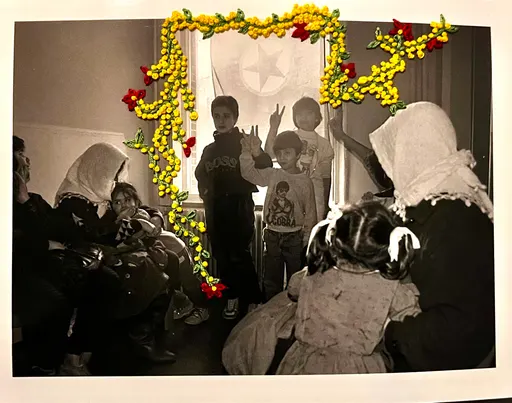
This project starts from black-and-white archival photos of Kurdish protests held in the Netherlands between the early and late 1980s. The photos come from the National Archives and constitute visual documents of the first moments of political visibility for the Kurdish diaspora in Europe. This period coincides with a historic turning point: the start of large-scale Kurdish migration to Europe. After the military coup in Turkey on September 12, 1980, political repression, mass arrests, enforced disappearances, and policies of cultural denial intensified. Thousands of Kurds were forced to leave their country and sought refuge in Europe. For them, migration was not just a geographic move but the continuation of political struggle in a new context and within a different public domain. The Kurdish diaspora did not remain silent in their host countries but instead transformed streets, squares, and public spaces into venues of political protest and collective memory. The archival photographs depict demonstrations, sit-ins, and hunger strikes organized in the Netherlands to draw international attention to the military regime in Turkey, the situation of Kurdish political prisoners, the Halabja gas attack, and the structural violence against the Kurdish population. At the same time, these protests served as spaces where a collective Kurdish identity in exile was formed and where political subjectivity took shape. This project does not approach the photos as closed documents of a bygone past. Through embroidery, the archival images are reworked and opened to the present. The embroidery is not a comprehensive intervention but a selective act focused on specific figures, banners, the edges of crowds, and the relationships between bodies. The threads sometimes frame the image but also regularly cross beyond the confines of the photo. This transgression refers to the spatial and temporal uncertainties of exile and the unfinished nature of diasporic existence. The use of color is limited but meaningful: red, yellow, and blue threads are added to the black-and-white images and refer both to symbolism within Kurdish political memory and to emotions of mourning, resistance, and collective solidarity. Floral motifs and repetitive patterns form a counter-movement within the often harsh and confrontational protest scenes, introducing slowness, care, and continuity. While photography fixes and shuts a moment, embroidery asks for time, repetition, and bodily engagement. In this project, embroidery is not decorative adornment but a methodological choice. The artist spends long periods of time on each image, looping stitches, pulling them apart, and reapplying them. The process can be linked to Walter Benjamin’s conception of history, in which the past is not seen as a closed phase of linear progress but as a rupture that is repeatedly invoked in the present and demands confrontation. Embroidery acts here as a material form of witness that reconnects these ruptures with the present. The work aligns with insights from diaspora and memory studies, which emphasize that exile does not end political struggle but shifts and reconfigures it. The struggle for rights that Kurds waged on European streets in the 1980s continues today in different forms. The embroidered archival photos portray the Kurdish diaspora not as passive objects of history but as political actors who actively carry, transform, and connect memory to the present, turning the archive into a living space of continued meaning-making. About Handan Tufan: Handan Tufan is an Amsterdam-based visual artist, photographer, and documentary maker. Her work explores the intersections of memory, exile, diaspora, and political witness. Combining archival imagery, oral history, photography, and textile interventions, she investigates how collective memory is carried, transmitted, and transformed. Tufan’s practice focuses especially on marginalized stories of communities with a migration background. Informed by feminist and decolonial perspectives, she foregrounds the relationship between individual life stories and structural historical violence. Embroidery and textile techniques serve not only as aesthetic means but as a methodology of slowness, care, and continuity. For the Amsterdam Museum she created "41 Keer Mashallah," visualizing the life stories of Amsterdam women from diverse communities through photography and narrative. For the Amsterdam Museum’s "Levenslijnen" project she examined loss, mourning, and intergenerational memory within the Kurdish diaspora in the Netherlands using oral history and archival material.